Leonardo da Vinci: The Renaissance Genius Who Revolutionized Art and Science
7 min read
Leonardo da Vinci, born in 1452 and died in 1519, was a renowned Italian painter and one of the greatest geniuses of his time. His remarkable masterpiece, the iconic "Mona Lisa", established him as one of the main artists of the Renaissance.
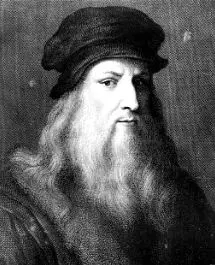
Although many of his works have been lost or remained unfinished, only 12 paintings of recognized authenticity are known, revealing the importance given by the artist to contrasts of light and shadow and, especially, to movement.
Although he stood out mainly in painting, Leonardo da Vinci was a genius in several areas, such as engineering, architecture, urban planning, mechanics, cartography, ballistics, hydraulics and anatomy, among others.
Born in the small village of Vinci, near Florence, Italy, on April 15, 1452, Leonardo lived with his mother until he was four years old and then went to live with his paternal grandfather. As a child, he demonstrated an aptitude for drawing and painting. At the age of 16, he was taken to Florence, where he worked as an apprentice in the studio of the renowned Florentine painter and sculptor Andrea del Verrocchio.
His first important work was his collaboration on Verrocchio's painting "The Baptism of Christ", in which he painted the "angels and the landscape to the left of the picture". Leonardo's talent was so evident that, at the age of 25, he joined the artists working for Lorenzo de' Medici, the famous patron who ruled Florence. In 1478, he received the commission to paint an altar panel for the chapel of São Bernardo in the Senhoria Palace.
In 1481, Leonardo was commissioned to paint a panel for the church of the friars of Saint Donato, in Scopeto, near Florence, but the work "Adoration of the Magi" was left unfinished. In the same year, at the age of 30, he moved to Milan and offered his services to Ludovico Sforza, the Duke of Milan, presenting himself as an engineer, architect and painter.
During his stay in Milan, in 1483, he painted the painting "The Virgin of the Rocks", two versions of which exist, one in the Louvre Museum and the other in the National Gallery in London. In 1485, Leonardo began painting "The Lady with an Ermine", portraying Cecilia Gallerani, the 14-year-old lover of the Duke of Milan. In 1495, he began preparations to paint "The Last Supper", a large fresco in the refectory of the Convent of Santa Maria delle Grazie, in Milan. The work took three years, with Leonardo redesigning and improving the supper figures.
Leonardo remained in Milan until 1499, designing the city's cathedral, but only created a sketch, ending up designing a broad system of canals and water supply, in addition to a complete urbanization plan for the city. In the same year, when the French invaded Milan, Leonardo returned to Florence.
Between 1500 and 1501, Leonardo traveled constantly. In January and February, he was at the court of Mantua, where he received the order for the portrait of Marchesa Isabel d'Este, but the work was not completed. In Venice, he studied the city's defensive system threatened by the Turks and designed huge catapults.
In 1502, in Florence, he was appointed Military Engineer and accompanied Cesare Borgia in his war ventures. In the same year, Leonardo began the famous painting of "Gioconda" (Mona Lisa), commissioned by Francesco del Giocondo, a wealthy Florentine, depicting his wife. In 1507, Leonardo was appointed painter and engineer at the court of Louis XII of France, taking with him the unfinished work of the Mona Lisa. It was that same year that he completed the painting, which would become one of the most famous in Western art and is today the main attraction of the Louvre Museum in Paris.
In 1510, Leonardo da Vinci completed the painting "Saint Anne, the Virgin and Child", which he had begun in 1503, commissioned for the main altar of the Church of Santa Annunziata, in Florence. In 1513, he went to Rome, where he was a protégé of Pope Leo X's brother and worked for Juliano de' Medici. However, Rome preferred younger artists such as Raphael and Michelangelo. At this time, Leonardo painted "Saint John the Baptist", probably his last work.
Leonardo da Vinci deepened his studies in mathematics and optics, dedicating himself to architecture, engineering and anatomy projects. His anatomical studies were considered disrespectful to the dead, as he performed dissection of corpses, an illegal practice and considered a sin by the Church. Leonardo confessed, on his deathbed, to having dissected thirty corpses to study the structure of the human body, writing down his observations in a peculiar way, written in reverse to be read in front of a mirror, which became known as his "Treatise on Anatomy". All of these studies were recorded in numerous drawings, including his famous work "Vitruvian Man", which represents the perfect proportions of the human body and is exhibited in the Gallerie dell'Accademia, in Venice.
With the death of Juliano de Medici, Leonardo accepted the invitation of French friends and left Italy definitively in 1516, taking with him his manuscripts, hundreds of drawings and three paintings commissioned but not delivered.
Leonardo da Vinci died at Cloux Castle, near Amboise, France, on May 2, 1519, during a visit from King Francis I. At the time of his death, Leonardo da Vinci was ill and faced with joint problems in his left hand. He spent his last days at Cloux Castle, where he was welcomed as a guest by Francis I.
In April 1519, Leonardo da Vinci was bedridden, surrounded by the three paintings that had become his faithful companions: the iconic Mona Lisa, the beloved work Saint Anne and the portrait of Saint John the Baptist. These masterpieces testified to the talents and genius of this great Renaissance master.
On May 2, 1519, Leonardo da Vinci died at Cloux Castle, at the age of 67. He was buried in the convent of the Church of Saint Florentin, in Amboise, France.
Leonardo da Vinci's death was an irreparable loss for the world of art and knowledge. His wide-ranging and multifaceted contributions to the fields of painting, engineering, anatomy, mathematics and many others continue to inspire and fascinate to this day.
Leonardo da Vinci left a lasting legacy and his work influenced countless generations of artists and scholars. His relentless quest to understand nature and his ability to capture the essence of the human form and beauty are evident in his surviving masterpieces, which stand as testaments to his unparalleled genius and creativity.
Chronology
- 1452: Leonardo da Vinci is born in Vinci, Italy.
- 1470: Beginning of learning to paint in Andrea del Verrocchio's studio in Florence.
- 1482: Leonardo moves to Milan and offers his services to Ludovico Sforza. 1495-1498: Works on the painting of the "Last Supper" in the Convent of Santa Maria delle Grazie, in Milan.
- 1503-1506: Begins painting of the famous "Mona Lisa".
- 1513: Leonardo leaves for Rome, where he studies mathematics, optics and anatomy.
- 1516: Leonardo accepts the invitation of Francis I of France and goes to Amboise.
- 1519: Leonardo da Vinci dies at Cloux Castle, in France.
- 1523: Leonardo da Vinci's notebooks are inherited by Francesco Melzi, his closest disciple.
- 1568: The first biography of Leonardo da Vinci, written by Giorgio Vasari, is published.
- 1630: Leonardo da Vinci's notebooks are rediscovered in Italian libraries.
- 1797: Napoleon Bonaparte removes the "Mona Lisa" painting from the Louvre and takes it to the Palace of Fontainebleau.
- 1804: The "Mona Lisa" is returned to the Louvre after the fall of Napoleon.
- 1870: The "Mona Lisa" is stolen from the Louvre, but is recovered in 1913.
- 1919: Leonardo da Vinci's notebooks are published in a complete edition.
- 1952: Leonardo da Vinci's "Vitruvian Man" is exhibited at the Galeria dell'Accademia in Venice.
- 2019: Celebrations around the world mark the 500th anniversary of Leonardo da Vinci's death. Leonardo da Vinci's legacy continues to inspire and delight people around the world, his work being studied and appreciated to this day.